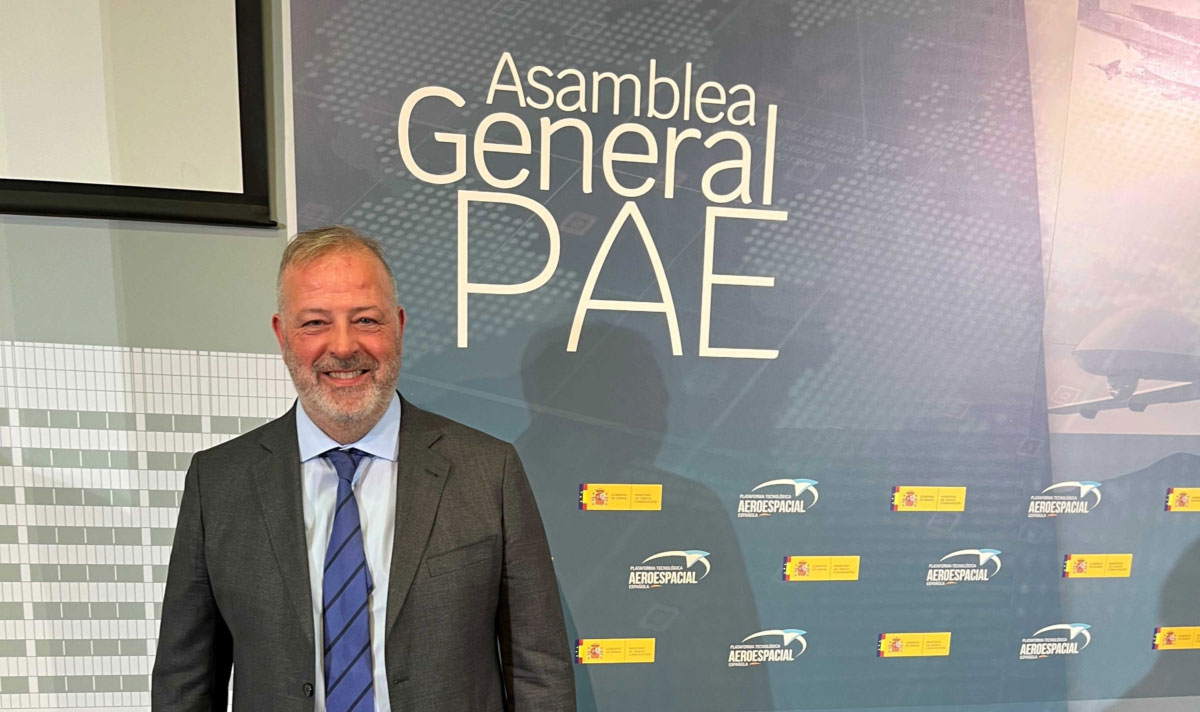

At the Extraordinary General Assembly held on June 15 by the Spanish Aerospace Technology Platform (PAE), an entity of which M&M Group is an associate company, the appointment of Airbus Defence and Space to the presidency of the PAE was confirmed following the proposal presented by the Management Board. In this way, Airbus has nominated Luis Guerra, VP Head of Space Systems Spain, who replaces Silvia Lazcano and assumes this position with the objective of “continuing to drive innovation, technological development and transformation to contribute to making the aerospace sector even more competitive and sustainable by working with all the actors that develop technology in this sector”, according to the PAE.
PAE’s previously elected Governing Council is made up of the companies Airbus Defence and Space, GMV, ITP Aero, Aernnova, Indra, Aciturri, Aertec and CiTD; the universities Carlos III of Madrid, Vigo, Politécnica de Valencia and Politécnica de Cataluña; and the technology centers Fundación CTA, ,FIDAMC, CATEC and Tecnalia.
In addition, the following are permanent members: the State Research Agency, the CDTI, TEDAE and the Secretary General of the PAE.
General Assembly
On the same day, the PAE General Assembly, chaired by Jaume Marcos (Airbus Operations), was held at the Ministry of Science and Innovation. The session was attended by the Secretary General of Innovation who opened the meeting and addressed a few words pointing out the importance of the aerospace sector and its investment in R+D+I and what PERTE Aerospace means to transform the sector. He also spoke about the role of the Technological Platforms in the transfer of knowledge between Universities, Technological Centers and Companies.
The aerospace sector has a great capacity as a driving force with important companies in addition to medium-sized companies (MidCaps) and Start-ups that provide new technological solutions to the projects. In this regard, he recalled the celebration of a conference on space entrepreneurship on June 23rd.
Miguel Belló (Commissioner for the Aerospace PERTE and Director of the Spanish Space Agency) spoke next. He presented the opportunities that the sector has, derived from the execution of the Aerospace PERTE.
- The Aeronautical Technology Plan (PTA), a successful execution in which there are already projects involving 8 million hours of work.
- The development of test centers for UAS such as the CEUS, which is added to others already existing and others to come for the testing of HALE type drones. Spain has a great opportunity to become the great drone test center in Europe.
- The Atlantic Constellation, whose funds come from the PGE (and not the NGF) to avoid the need to finalize the project in 2025.
- The QKD initiative will be developed in two parts, one, via ESA, giving solutions in GEO and the other, with a solution in LEO that will be formalized through an Innovative Public
- Procurement.
- The Space Technology Plan (PTE), endowed with 70 M€ and soon to be launched
- The Spanish Space Agency is playing a role in international relations and has already resulted in bilateral meetings with several space agencies around the world. In addition, Spain has been invited to participate in the G20 Space meeting.
- The IRIS2 constellation.
- Defense projects, in many cases with dual technologies.
- The European initiative to have a manned flight launch capability (with a program that could have a budget of about 30 B€).
These latter issues will be discussed at an ESA Council meeting to be held in Seville this autumn to coincide with the Spanish presidency of the EU.
Belló also spoke of the challenges facing the sector:
- The decarbonization of aviation.
- The development of new space with thousands of satellites in orbit and the need to manage space traffic, a field in which Spain is very well positioned.
- The need to change the paradigm of space production from prototypes to series production.
- The talent
- Investment capacity and the need for investment funds with the technical capacity to value space projects.
- The very short deadlines imposed by the NGFs in PERTE.
For his part, Jaume Marcos spoke of the recovery of the sector after the COVID crisis, what the challenge of decarbonization means for civil aviation with the development of zero emission aircraft, new space (constellations, launchers), helicopters and the opportunity that appears with Urban Air Mobility and the competitiveness of companies.
He thanked the AEI for its confidence in the PAE project in the call for aid to Platforms and the Ministry for its support to the sector. On the day the Assembly was held, PAE had 124 members and aims to help solve the aforementioned challenges through R&D&I solutions involving companies, universities and technology centers.
After these interventions, the PAE formalized the appointment of honorary members to Plácido Márquez and Silvia Lazcano, the former presidents of the PAE for their contribution to turn the Platform into a reference organization for the aerospace sector in Spain.