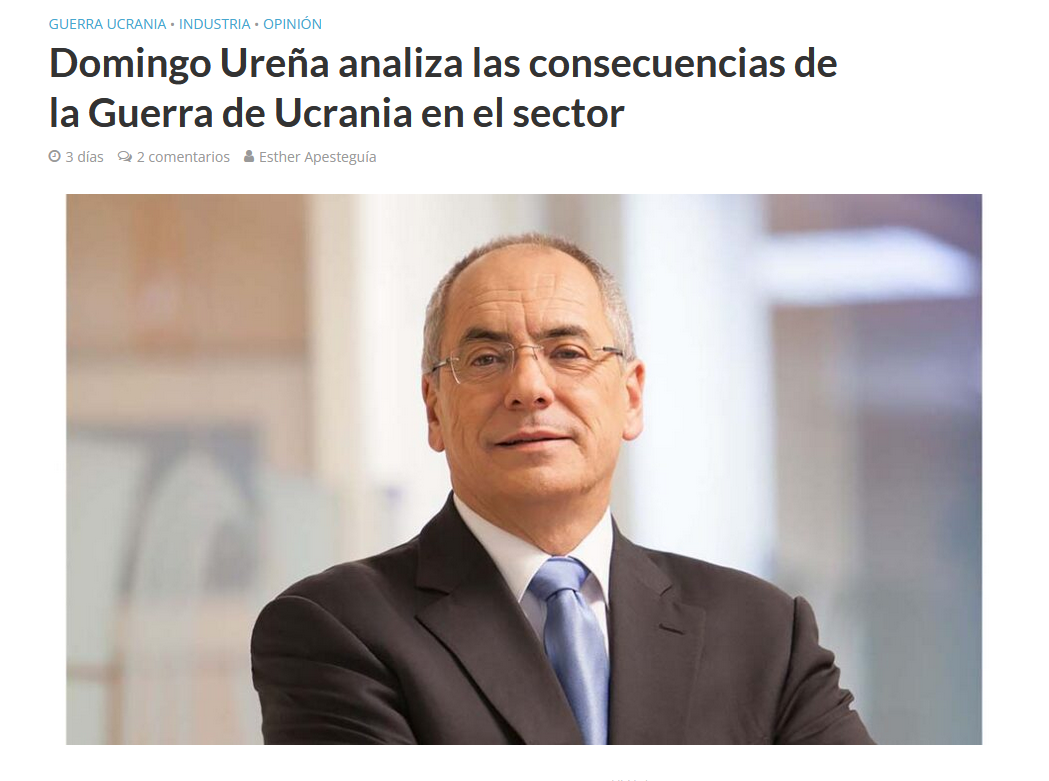

In this opinion article Domingo Ureña, CEO of M&M and former president of Airbus in Spain, offers a long-range view of the foreseeable consequences that the war in Ukraine will have on the aerospace sector.
In the wake of the pandemic, the Ukraine crisis has reaffirmed a paradigm shift in the aviation and air transport industry. The danger of shortage of raw materials, both for the construction of aircraft and energy, the closure of Russian airspace, as well as the need to strengthen and launch a Europe of defense, as already exists in other areas, after the evidence of the dangers lurking on several borders of the European Union, are the issues that Ureña analyzes.
1.- SUPPLY CHAIN
Russia, and other countries with geostrategic and political regimes and interests very different from those of the West, are a fundamental supplier of raw materials for the aeronautical industry.
The economic sanctions that have been decided as one of the ways for Russia to desist from its offensive against Ukraine, among them the ban on importing Russian raw materials, are planning on the future strategy of the aeronautical industry. Therefore, OEMs and Tiers-1 could consider a change in the geographical location of their supply chain, trying to select their suppliers in less exposed and/or more stable places within the geopolitical situation. The embargo measures against Russia may seriously affect the supply of materials such as titanium, aluminum or other special materials, which this country supplies on a preferential basis.
The situation will force us to look for solutions within the countries considered stable, promoting/reinforcing supply chains of raw materials for the industrial needs of the West, and achieving greater autonomy in the future. We are already witnessing operations that make sense within the framework of this new strategy. For example, Safran, the French engine manufacturer, Airbus itself and the Tikehau ACE Capital equity fund, the same fund that manages the Spanish aerofund, took a stake in Auber&Duval. It was a rescue operation for the French mining giant, in serious difficulties, with the aim of securing the supply of these materials for the civil aviation, military, engine and nuclear industries.
Nor should it be forgotten that the supply chain is coming from a very complicated situation due to the Covid-19 crisis. Now, faced with the new challenges of rising raw material and energy prices, rising wages due to high inflation and possible supply problems due to the also complicated situation of the global logistics chain, it is imperative that the end customers of the product assume an increase in the price of the components. If this does not happen, the supply chain of the large OEMS, from Tier-1 to lower levels of suppliers, could be in serious trouble. Pressure on suppliers has been installed in the aerospace industry on pricing for years, and in a scenario of steadily rising prices, the outlook may be complicated.
“Russia’s invasion of Ukraine will speed up processes that were already part of the strategy of the large aeronautical OEMs”.
2.- PROGRESS IN SUSTAINABILITY
In terms of fuels, the situation of high prices could lead to an acceleration of synthetic fuels, SAF, which would lead us to less dependence on fossil fuels, and thus accelerate the decarbonization of aviation. The underlying idea would be the same, to reduce energy dependence on these countries, and the aviation sector in general is immersed in the process of developing less polluting propulsion alternatives to achieve the goal of zero emissions by 2050.
3.- CHANGE IN NEW AIRCRAFT DELIVERIES?
Another of the consequences we have seen with the invasion of Ukraine is the closure of Russian airspace. Russian territory is crossed daily by hundreds of aircraft on their routes to or from Asia to Europe and America. This closure has meant that these flights have to go around Russia, so the routes are longer, with the consequences of needing longer range aircraft for some routes.
It is true that it is too early to estimate the impact on deliveries of new aircraft due to this circumstance, but at the same time it would not be improbable to think of a different distribution of production forecasts between single-aisle and wide-body aircraft, in order to cover the need for greater range on a number of routes.
4.-.REACTIVATION OF DEFENSE EUROPE
Undoubtedly, one of the sectors that will be most affected -in a good way- is the defense sector. Finally, we will now have a common defense policy, which will have a positive impact on ongoing programs, acquiring a greater number of products, as well as the acceleration of future programs that had been put on hold, such as the FCAS, which was kept in a drawer for a year due to several factors, among them the continuous clashes between the French coordinator of the program, Dassault, and the German coordinator, Airbus.
Also weighing on this program is the fact that there is another very similar program, the Tempest, in which the United Kingdom – BAE -, Italy – Leonardo and Sweden – Saab – are involved. In everyone’s mind there is a rethinking of launching two programs with similar characteristics, with investment requirements in the millions of millions. There has been talk of the possibility of combining both developments in a single program, which would make their development cheaper and would banish the diversity of materials that exists in Europe and which is also economically damaging.
“If there is one thing clear, it is that we have to secure our national/European sovereignty that has been neglected for years. Losing design capability, technology that we will now have to regain in spurts as well as agreements in short time periods FCAS, MALE, and others.”
The fact that the United Kingdom has left the European Union, could be the main stumbling block, although there is nothing that with good negotiation can’t be bridged.
We are also going to see how American material begins to equip European armies. The latest news accompanying this information is the German decision to incorporate Lockheed Martin’s F-35 to replace part of its Tornado fleet.
This decision has been made because the Eurofighter cannot carry B-61 free-fall nuclear bombs. Whereas the F-35, as well as the F-18, do have this capability. Putin, and his nuclear threat, have caused him to start rethinking European equipment.
Originally published in Fly News