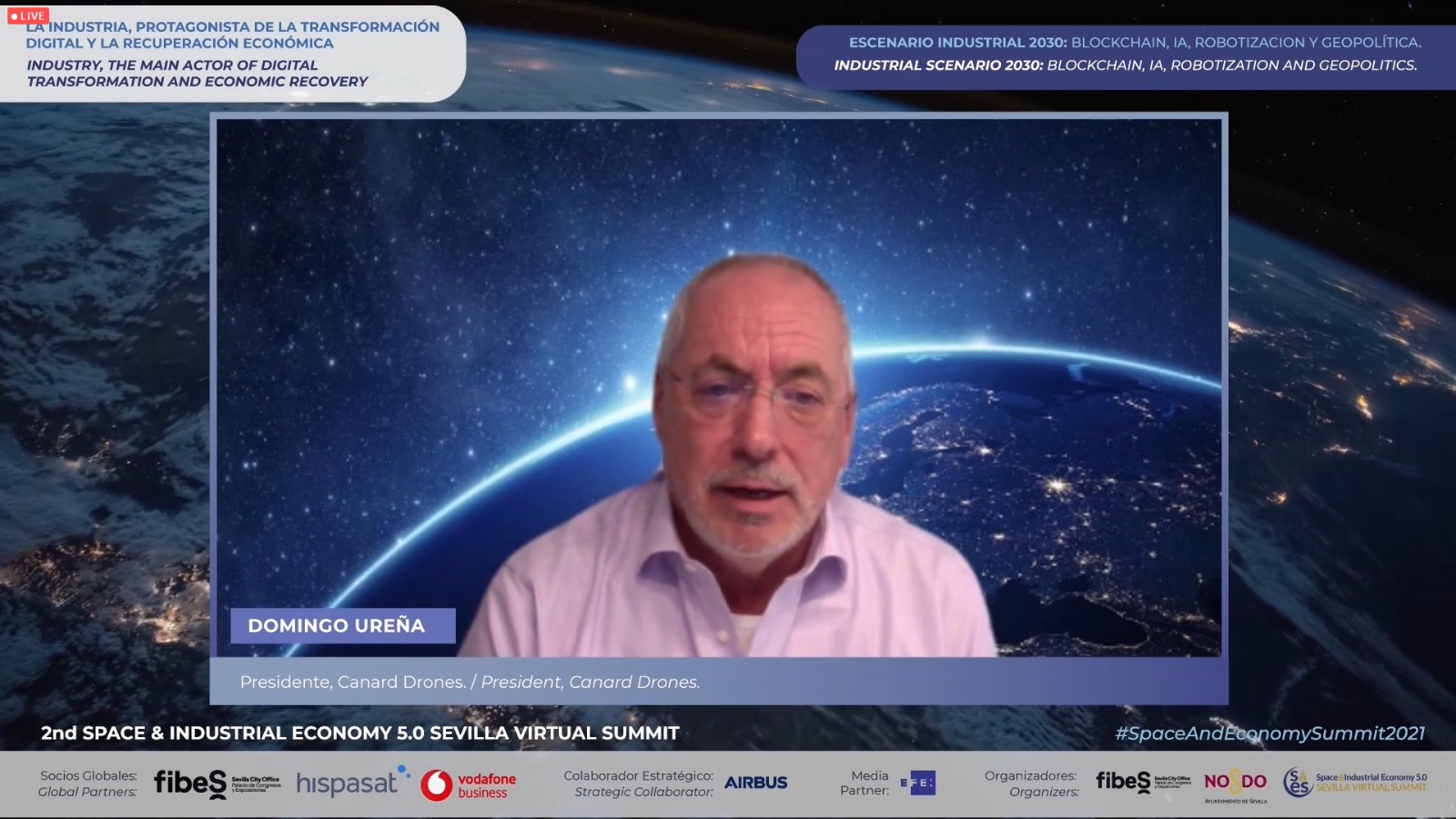

On Thursday, December 2, the president of MyM, Domingo Ureña, has participated, as president of Canard Drones, in the 2nd Space & Industrial Economy 5.0 Sevilla Virtual Summit, a virtual initiative, co-organized by Ayuntamiento de Sevilla and Fibes Sevilla, with the aim of promoting to the whole world a greater knowledge of the new Spanish industry, highly qualified, from an innovative, technological, global vision and with parameters of sustainability and growth.
Ureña was one of the speakers at the round table “Industrial Scenario 2030: blockchain, AI, robotization and geopolitics” together with José María Anguiano, partner at Garrigues, and Francisco Mochón Morcillo, president of CTA (Corporación Tecnológica de Andalucía). During his speech, Ureña stressed that with Artificial Intelligence we can identify undesired effects, analyzing and making the system intelligent to make forecasts, for example, in the identification of dangerous objects on runways; the inspection of pavements, identifying the type of cracks and how they can affect them, or in providing more security in perimeter control. In this sense, Ureña highlighted that there will be more and more systems that predict security issues and the future tends to 100% independent drone systems.
Regarding blockchain, the president of Canard Airdrones was categorical: “It’s here to stay; it’s going to be a necessity. In the aeronautical sector there are already companies that demand the establishment of the blockchain to communicate between companies, because it allows you to securely all kinds of communications. In a few years it will be a reality; another thing will be its legislation, which comes after the technological development, since the regulation comes on the basis of what is generated in the technological or industrial part”.
In this sense, Domingo Ureña has pointed out that we are in a phase of automation and today airplanes can make flights almost automatically. “We will reach robotics, where machines will be able to make decisions with verifiable data. No one can stop this process, so we have to take advantage of this fourth industrial wave in which speed is tremendous and reaction time is short.”
Impact on employment and training
Regarding the expected evolution of training and employment in adapting to these new technological processes, he pointed out that “industry is never sufficiently trained to take on changes, and in the future we will continue to be in the midst of transformation. The impact of employment with all these technologies is relative, we cannot be afraid, because new opportunities are opening up. Technology is going to evolve, at a global level, so you cannot isolate yourself as it is an integrating process through a technology that is very accessible to everyone”.
In this way, according to Ureña, the impact will be positive: “Governments, industries and universities will be forced to have a state pact. There will be a greater rapprochement between universities and companies, constantly generating new training, new jobs with new subjects, new relationships with researchers”.
On the other hand, and in reference to the impact of the European Funds for Next Generation, Domingo Ureña assured that the companies are prepared, but not the political sphere and institutions.
In reference to the challenge that the implementation of this type of technologies represents for the SMEs, he reminded that in the aeronautical sector in Spain, 60% of the companies have less than 40 employees and low invoicing, remunerations that do not allow the implementation of new technologies”. In this sense, he added that Spain is a great generator of future value with start ups, “but they do not have an engine that drives them to create companies. We have a tendency to be small, so we must move towards greater concentration. Our country has a great capacity to generate ideas and talent. What are we lacking? A consensual national strategic plan and everyone rowing in the same direction”.
In his final conclusion, Ureña was optimistic: “We cannot stop, we have to get on the bandwagon of these new technologies, and whoever does not do so will be left behind. We have great professionals and universities, all the ingredients are there, but we need, on the one hand, to concentrate companies to gain muscle and, on the other hand, that the Administration accompanies us instead of putting sticks in the wheels, because it will not be able to stop what is coming”.
It should be noted that this meeting was attended by personalities such as the President of the Government, Pedro Sánchez, and the President of Airbus Spain, Alberto Gutiérrez. In his speech, Sánchez announced the forthcoming approval of the aerospace PERTE, with an allocation of 400 M€ of state investment. All indications are that the plan will focus on zero-emission aircraft and a constellation of satellites (Atlantic Constellation) for observation and control of oceans, coasts and forests as a complement to Copernicus. He has also announced the creation of the Spanish Space Agency.